
Player guide
The market
The market doesn't sit still. Rates move, districts drift, prices follow the cycle, and rival brokers buy whatever you leave on the table.
Updated October 20, 2026
The cycle
The whole city moves through six phases. The phase sets where interest rates head, how buildings are priced, and how fast rents grow.
| Phase | Benchmark rate heads to | Asking prices | Rents |
|---|---|---|---|
| Boom | 4.25% (lowest) | Highest | Rising fast |
| Hot | 4.75% (low) | High | Rising |
| Stable | 5.25% (normal) | Normal | Rising slowly |
| Cooling | 6.00% (higher) | Lower | Barely rising |
| Downturn | 6.75% (high) | Low | Falling |
| Distress | 7.50% (highest) | Lowest | Falling faster |
- Boom. Buildings are worth the most. A good time to sell or refinance.
- Hot. Values climb, and bargains get bought fast.
- Stable. Prices steady. A good month to buy carefully.
- Cooling. Values slip, and sellers start to listen.
- Downturn. Values fall. Distressed owners sell cheap.
- Distress. Fire sales everywhere. Cash is king.
The first years of every career follow a set course: Stable, then Hot (around month 12), then Stable (around month 24), then Cooling (around month 34), then Downturn (around month 44), then Stable (around month 54). That way every player sees a hot market, a cooling and a downturn while they're still learning. After about month 54 it's unscripted: a phase lasts 8 to 16 months, and nobody knows which way it turns next.
The phase also moves cap rates, the yield buyers demand. When cap rates fall, buildings are worth more for the same income; when they rise, worth less. Your buildings' values, your refinance cash-outs and your net worth all move with it.
The benchmark rate
Every new loan is priced off a benchmark interest rate. Each month it drifts toward where the cycle wants it, from 4.25% in a boom to 7.50% in distress (5.25% in a stable market), with a little noise along the way. When it moves, the month-end reveal tells you where bank loans now start.
The rate matters twice: when you buy (a higher rate means bigger payments, and the bank's coverage test gets harder to pass) and when you refinance (a new loan is priced at today's rate). Loans have fixed rates, so a building you already own keeps its rate until you refinance it.
Districts drift
On top of the cycle, each district heats up or cools off on its own, a little each month, and slowly drifts back toward the city's average. A district heating up means its buildings are worth more. The month's biggest mover in a district you can work in makes the reveal: "Midtown heats up", for example. See Districts.
Listings come and go
When a building comes up for sale, its asking price is set by the market at that moment: high in a boom, low in a downturn, with some variation either way. After that:
- Bargains (priced under what their income is worth) get bought quickly, often by a rival.
- Fair prices sell now and then.
- Overpriced buildings sit, and every couple of months the seller cuts the price until it's fair.
- Fire sales appear in a downturn or distress: buildings at a deep discount. You get the first month on each before rivals can move.
The market also changes the deals themselves. In a hot market inspections turn up more problems and sellers give fewer credits; in a weak one, the reverse. See Buying and financing.
Rival brokers
You aren't the only broker in town. Rivals buy the bargains you leave sitting, a few a month at most, and the reveal tells you what they took and for how much. Once your Market is open, the first time a rival snipes a building while you're shopping, Rivals opens on You.
Each district has a rival broker, and you race them for it: the first to the target in turf points wins. A deal you close there scores 1 (a whale 3) and a building you buy there scores 3. They score every month, and for every listing or lead they take. Beat them and they retire. A rival may also make a hostile offer on one of your buildings: take the money or say it's not for sale.
The race for #1
The city keeps a leaderboard of the top brokers by net worth. When the race for #1 is close, the month-end reveal says so in one line, like "You're 8% behind Anika Reyes for #1", or, when you lead, how close the top rival is. Take #1 and you make the front page.
Boss seasons
From year six, each year can open a boss season against the strongest rival still racing you. Their turf race gets the year's end as a deadline, and they make boss bids for your buildings in their district: more than the building is worth, but selling hands them turf.
Path nemeses
Each career path has its own specialist rival, separate from the district rivals. Once your path reaches Bronze, they notice you, and about once a year they buy the best listing of their kind before you can.
The month-end reveal
When you end a month, the reveal plays the news beat by beat, biggest first: the cheques, the keys, a promotion, the deal that fell through. When the month makes the news, it opens on a front page of the Skyline Herald, spinning in like an old film: your first building, a landmark, a big payday, a rival retiring, #1 in the city, or a turn in the market.
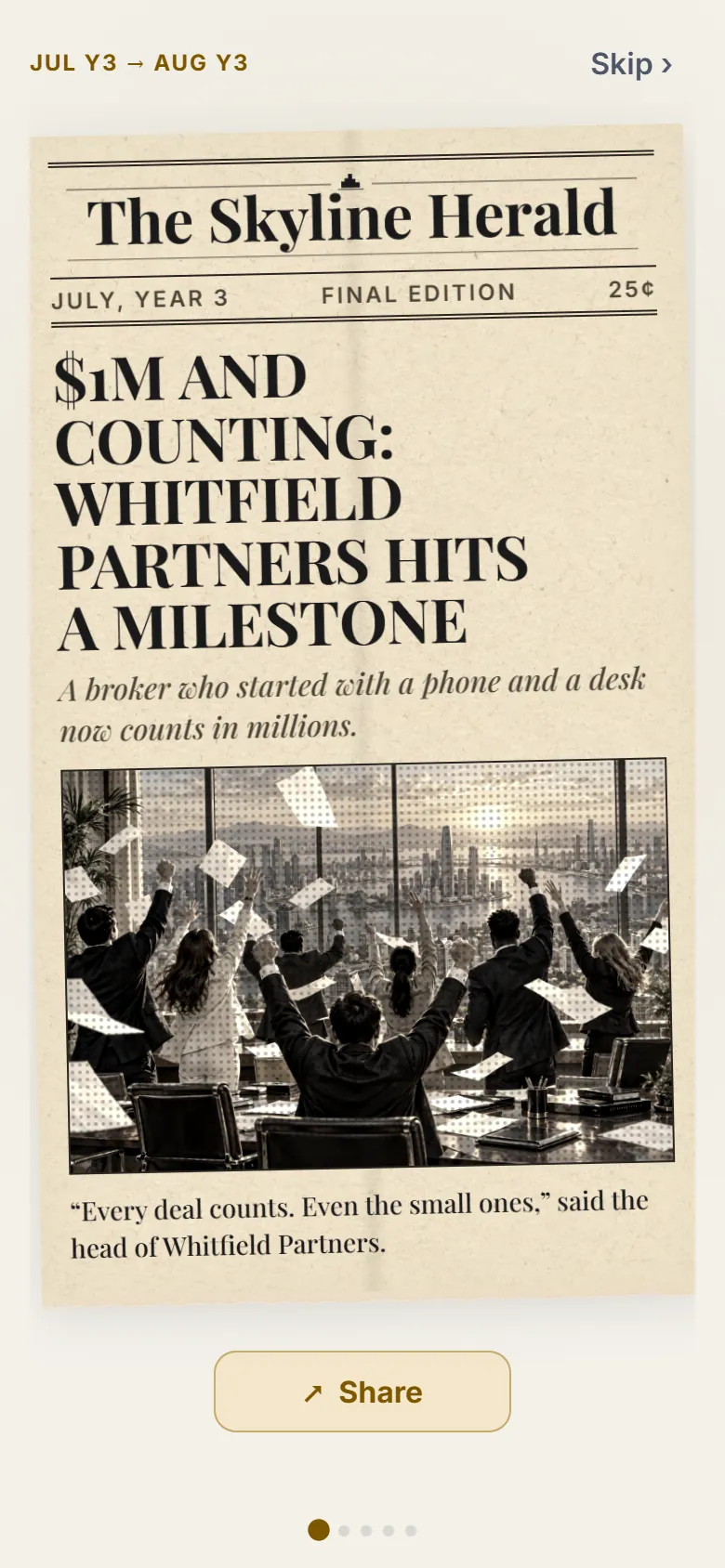
Then the market: a phase change, the rate, a district on the move, listings sold to rivals, new listings, price cuts and new leads. There's often a rumor. It ends on your net worth and what moved it, with a line against your best finished career so far (see Career and score). Each December's reveal ends with your year, wrapped.
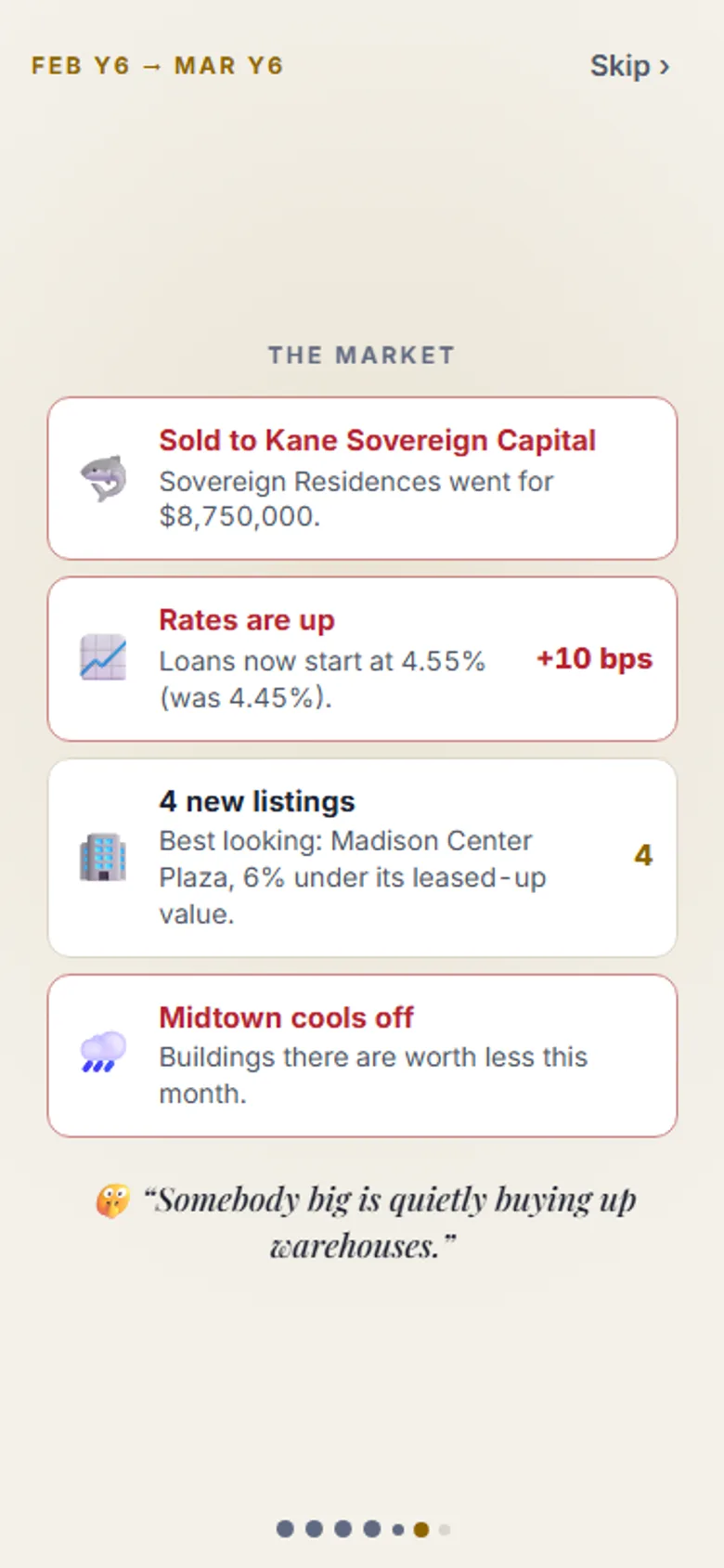
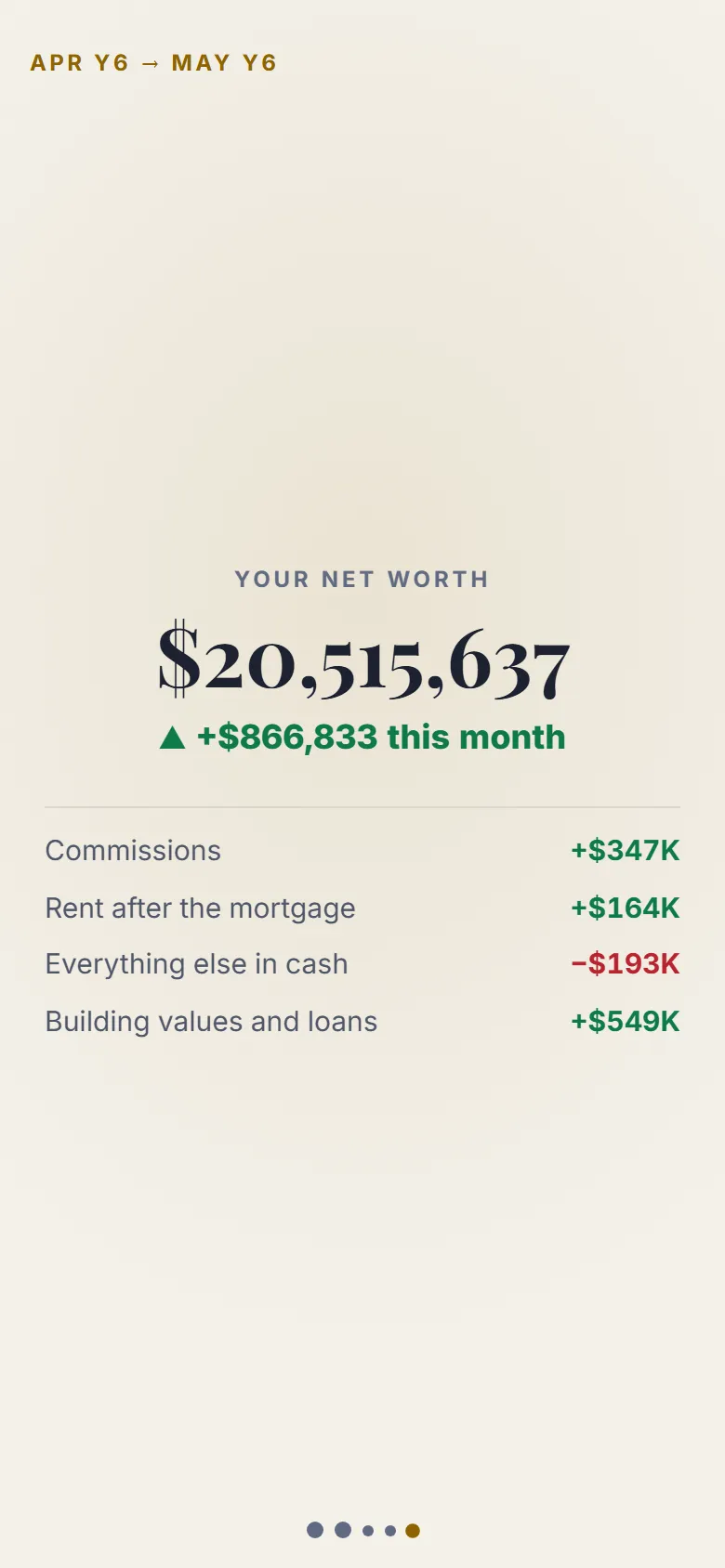
It's worth reading before you play the next month. A downturn is when the bargains appear, and a boom is when your buildings are worth the most.
Try it on a real career
Free in your browser, on your phone or desktop. No download, no account.