
Learn
What is a cap rate?
The one number every commercial real estate conversation starts with, what it measures, and where it misleads.
Updated October 6, 2026
Ask a commercial broker about a building and the first number you hear is usually the cap rate. "It's trading at a six" means the building is priced at a 6% capitalization rate. The idea is simple, and once it clicks, you can read most commercial real estate deals.
The definition
The capitalization rate is a building's net operating income for one year divided by its value or price:
Cap rate = annual NOI ÷ value
Net operating income (NOI) is the rent and other income the building actually collects, minus the costs of running it: property taxes, insurance, repairs, utilities the owner pays, and management. It leaves out loan payments, income taxes and depreciation. (There is a full guide to NOI if you want the details.)
Put plainly, the cap rate is the yield you would earn in year one if you paid all cash. A 6% cap rate means each $100 of price buys $6 a year of operating income.
A worked example
A small retail strip is offered for $2,000,000. Its numbers for the coming year:
| Line | Annual |
|---|---|
| Potential rent, fully leased | $200,000 |
| Less vacancy and credit loss (8%) | −$16,000 |
| Effective gross income | $184,000 |
| Less operating expenses | −$64,000 |
| Net operating income | $120,000 |
$120,000 ÷ $2,000,000 = 6.0%.
The formula also runs backwards, and this is how it gets used most often. If similar buildings nearby are selling at a 6.5% cap rate, the market value of this one is $120,000 ÷ 0.065 = about $1,846,000. The seller's $2,000,000 asks for a 6.0% cap, so the price is rich for the area unless something justifies it, such as better tenants, longer leases or a better corner.
Why a small change in cap rate moves value a lot
Because value is NOI divided by the cap rate, small moves in the rate swing values hard. The same $120,000 of NOI is worth:
- $2,400,000 at a 5% cap rate
- $2,000,000 at 6%
- $1,714,000 at 7%
At these levels, one point of cap rate is a 14–20% change in value with no change in the building. That is why owners care about "cap rate compression" (rates falling, values rising) and dread expansion. The same logic works on income: at a 6% cap, every extra $1 of annual NOI adds about $16.67 of value. Cutting a $6,000 expense adds roughly $100,000 of value.
What makes a cap rate high or low?
A cap rate is the market's price for risk and growth. Buyers accept a lower yield when the income is safe and likely to grow, and demand a higher one when it isn't. The main drivers:
- Location. Deep, liquid markets and prime streets trade at lower cap rates than small towns or weak blocks.
- Building quality. Newer Class A buildings trade lower than tired Class C ones that need work.
- Tenants and leases. A ten-year lease to a creditworthy national tenant is worth more per dollar of rent than month-to-month tenants.
- Property type. Investors price apartments, warehouses, offices and shops differently, and those preferences change over time.
- Interest rates. When borrowing costs rise, buyers need higher yields and cap rates tend to rise, though with a lag and not one-for-one.
So there is no single "good" cap rate. A high cap rate is not a bargain if the income behind it is about to walk out the door, and a low one is not overpriced if the rent is set to climb. The useful question is how a building's cap rate compares to similar buildings in the same market at the same time, and why it differs.
What a cap rate doesn't tell you
- Financing. Cap rate ignores debt. Your actual return depends on the loan. Cash-on-cash return (annual cash flow after debt service ÷ the cash you put in) captures that.
- The future. It is one year's income. A half-empty building has a low cap rate on today's income and may be a great buy if you can fill it.
- Capital costs. A roof replacement or a new tenant's build-out sits outside NOI but comes out of your pocket.
- Whose NOI. Sellers' brochures often show "pro forma" NOI, the income they hope a buyer will reach. Always ask for the actual trailing twelve months.
Cap rates in CRE Tycoon
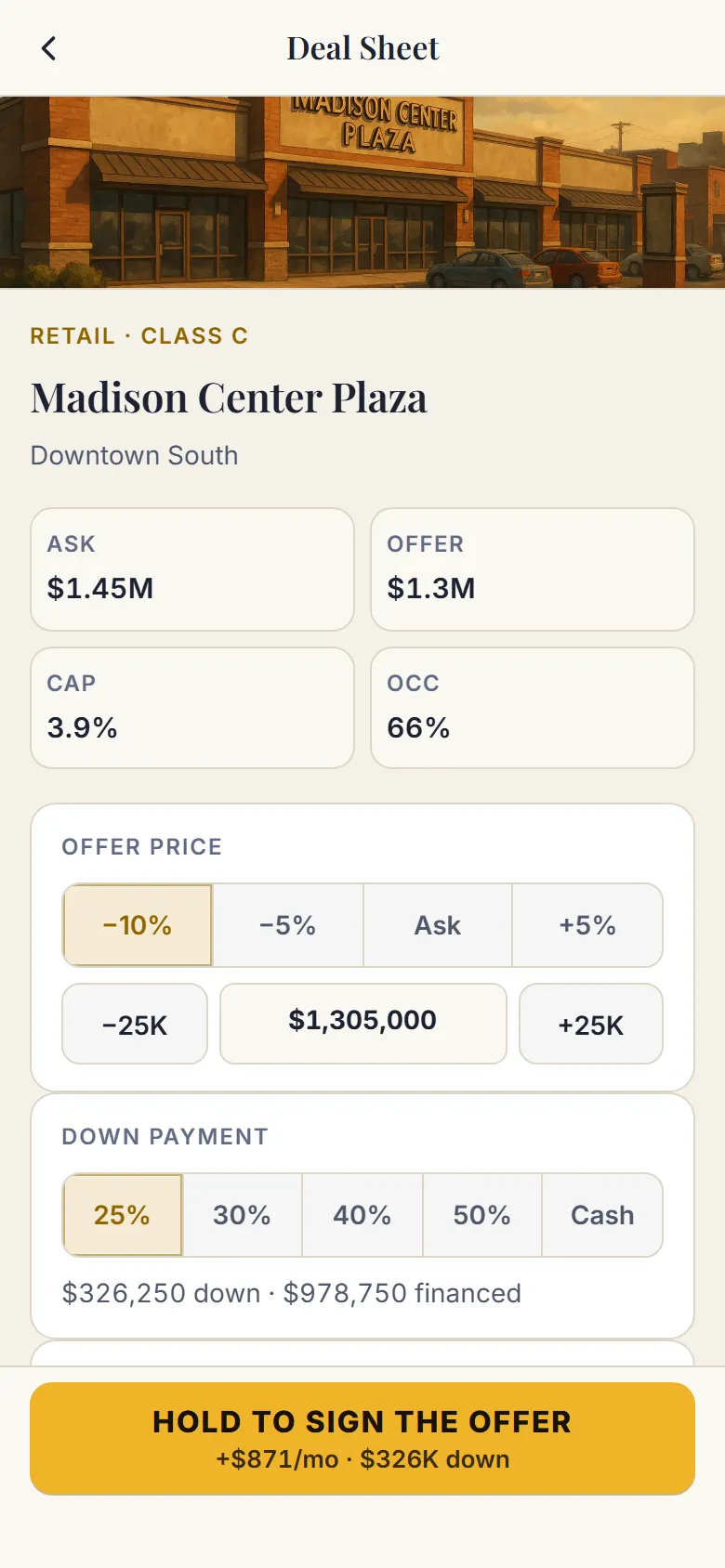
Every building in the game shows a cap rate on its deal sheet, and the game values the buildings you own the same way an appraiser would: NOI divided by a cap rate. Listed buildings in the game's data range from about 4.9% to 8.3%.
The cap rate a building is valued at moves with three things you can see. The market cycle pushes it up in a downturn and down in a boom. Building class matters: lifting a tired Class C building to a better class through a business plan compresses its cap rate. And the Curb appeal upgrade track trims it a little at each level.
The lesson the game teaches fastest is the one above about half-empty buildings. A building at 66% occupancy shows a thin cap rate on today's income. Lease it up, and NOI rises while the cap rate the market applies stays roughly put, so value jumps. That gap between what you paid and what the stabilized building is worth is where both the sale windfall and therefinance come from.
The short version
- Cap rate = annual NOI ÷ value. Value = NOI ÷ cap rate.
- Lower cap rates mean higher prices for each dollar of income, and usually lower perceived risk.
- Compare cap rates only between similar buildings in the same market at the same time.
- It ignores debt, future growth and capital costs, so it starts the analysis; it doesn't finish it.
Try it on a real career
Free in your browser, on your phone or desktop. No download, no account.