
Learn
Real estate games worth playing
Board games, city builders, renovation sims and tycoon games all touch property in different ways. Here's what each kind does well.
Updated October 6, 2026
"Real estate game" covers very different things. Some are family board games about rent and luck, some put you in charge of a whole city, some are about fixing up one house, and a few try to model investing. None of them is the best at everything, so this list says what each is good at and what it leaves out. Yes, we make one of them; it's here too, described as plainly as the rest.
Board games
Monopoly
The one everyone knows. Published by Parker Brothers in 1935 and now owned by Hasbro, it descends from Lizzie Magie'sThe Landlord's Game, patented in 1904. You buy properties as you land on them, complete color sets, build houses and hotels, and collect rent until the other players go bankrupt.
Good at: the feel of owning a street, the leap in rent from improvements, and trading between players, which is genuine negotiation. Leaves out: running costs, vacancy, changing rents and values, and useful debt. We go through this in detail in Monopoly vs real estate.
Acquire
Sid Sackson's classic from 1964. Players place tiles to found and grow hotel chains, buy shares in them, and cash in when one chain merges into another.
Good at: thinking like an investor rather than a landlord: backing what will grow, timing mergers, and the payoff of being a major shareholder. Leaves out: buildings, rent and operations; it's really about equity, not property.
Cashflow
Robert Kiyosaki's board game, from the author of Rich Dad Poor Dad. Each player has a job, a salary and monthly expenses, and tries to escape the "rat race" by buying assets, including rental property, until passive income covers expenses.
Good at: personal cash flow, the idea that assets should pay you, and reading a simple income statement.Leaves out: realistic deal analysis; the property deals are simplified cards, and the game carries its author's particular philosophy about money.
City builders
SimCity
Will Wright's city simulator, first released by Maxis in 1989, with many sequels. SimCity 4 (2003) added regions of neighboring cities. You zone land, lay roads and services, and balance the budget while the city grows.
Good at: showing how land value responds to transport, services, pollution and crime, which is the backdrop every real estate investor works against. Leaves out: ownership. You're the mayor; the buildings belong to simulated citizens.
Cities: Skylines and Cities: Skylines II
Developed by Colossal Order and published by Paradox Interactive; the first game came out in 2015 and the sequel in 2023. They are the best-known modern city builders, with detailed traffic, zoning and public services, and a large modding community on PC.
Good at: scale, traffic and the way infrastructure shapes where demand goes. Planning a district from empty land is deeply satisfying. Leaves out: property finance; like SimCity, you plan the city rather than own its buildings.
Renovation and property sims
House Flipper
A first-person simulator, first released in 2018, in which you clean, repair and redecorate houses, and buy run-down homes to renovate and sell.
Good at: the hands-on satisfaction of turning a wreck into something nice, and the basic idea that improvements add value. Leaves out: the numbers. Financing, rental income and market timing aren't what it's about.
Location-based property games
Mobile games such as Landlord GO let you "buy" real places on a map, such as shops, landmarks and addresses near you, and earn in-game rent from them.
Good at: making property collecting feel connected to the real world, and playing in short bursts.Leaves out: most of how property is valued and financed; the economics are a collection game, not a market.
Online Monopoly-style games
Games such as Business Tour take the roll-and-buy board game format online, with quick matches against other people.
Good at: fast, social, competitive sessions if you like the Monopoly loop. Leaves out: the same things Monopoly does.
Tycoon and business sims
Classic tycoon games
The tycoon genre, from Capitalism (1995) to RollerCoaster Tycoon (1999), is about running a business: pricing, costs, expansion and competition. Many PC and mobile "real estate tycoon" games follow the same pattern with buildings that produce income and can be upgraded.
Good at: the satisfying loop of reinvesting profit to grow. Leaves out: it varies a lot. In many real estate tycoon games income simply ticks up, with little sense of vacancy, debt or market cycles. Check whether a game has loans and changing values before expecting it to teach investing.
CRE Tycoon
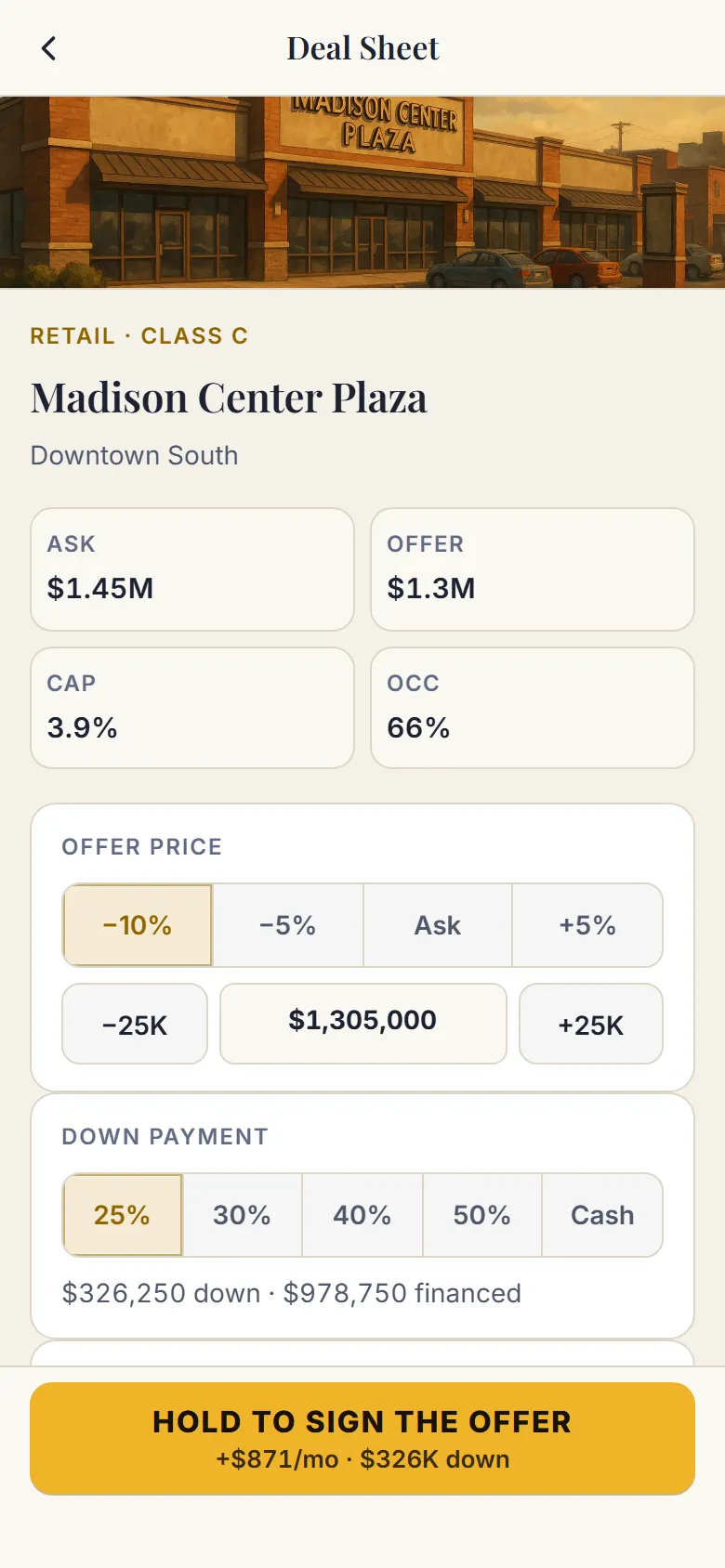
Our commercial real estate game, a commercial real estate simulation free in the browser on phones and desktop, with no download and no account (sign-in is only for the global leaderboard). You start as a commercial real estate broker with $100,000, earn commissions on deals, and use them to buy buildings with a down payment and an interest-only loan. Business plans lease buildings up, 6 upgrade tracks improve them, and once a building is stabilized you can refinance it for tax-free cash or sell it. The market moves through cycles, the benchmark loan rate changes, and rival brokers compete for bargains across 4 districts and157 buildings.
A career is 120 months, ten years of game time, on a real-time clock: a new month becomes available every hour, and up to 6 can be banked. Your score is your net worth at the end.
Good at: the financial side: net operating income, cap rates, leverage, refinancing and timing a sale.Leaves out: building a city, decorating anything, and playing against friends at the same table. It's played a few minutes at a time, so if you want a long single sitting, a city builder will suit you better. It also has its share of luck, in prospecting mini-games and building events.
Which one to pick
| If you want… | Try |
|---|---|
| A game night with family or friends | Monopoly or Acquire |
| To think about personal finances | Cashflow |
| To plan and build a city | SimCity or Cities: Skylines |
| The satisfaction of renovating | House Flipper |
| Quick property collecting on your phone | A location-based game such as Landlord GO |
| The investing side: income, debt, refinancing, cycles | CRE Tycoon |
If you're playing to learn, pair any of them with the basics: cap rates,net operating income and refinancing.
Try it on a real career
Free in your browser, on your phone or desktop. No download, no account.