
Player guide
Brokerage
The brokerage is where the big cheques start. Find leads at the prospecting tables, turn them into clients and listings, and get the deal through escrow.
Updated October 20, 2026
Finding business: the tables
Prospecting lives at the top of the Pipeline tab, under Prospect for leads. Each way of finding business is a table with its own game, and each costs actions: a table that costs more has fewer misses and stronger leads. At first only Cold Calls is open; the others are earned.
| Table | Game and cost | What it's for | Opens |
|---|---|---|---|
| Cold Calls | Three-window reveal · 1 action | Dial, then open the windows to see who picked up | From day one |
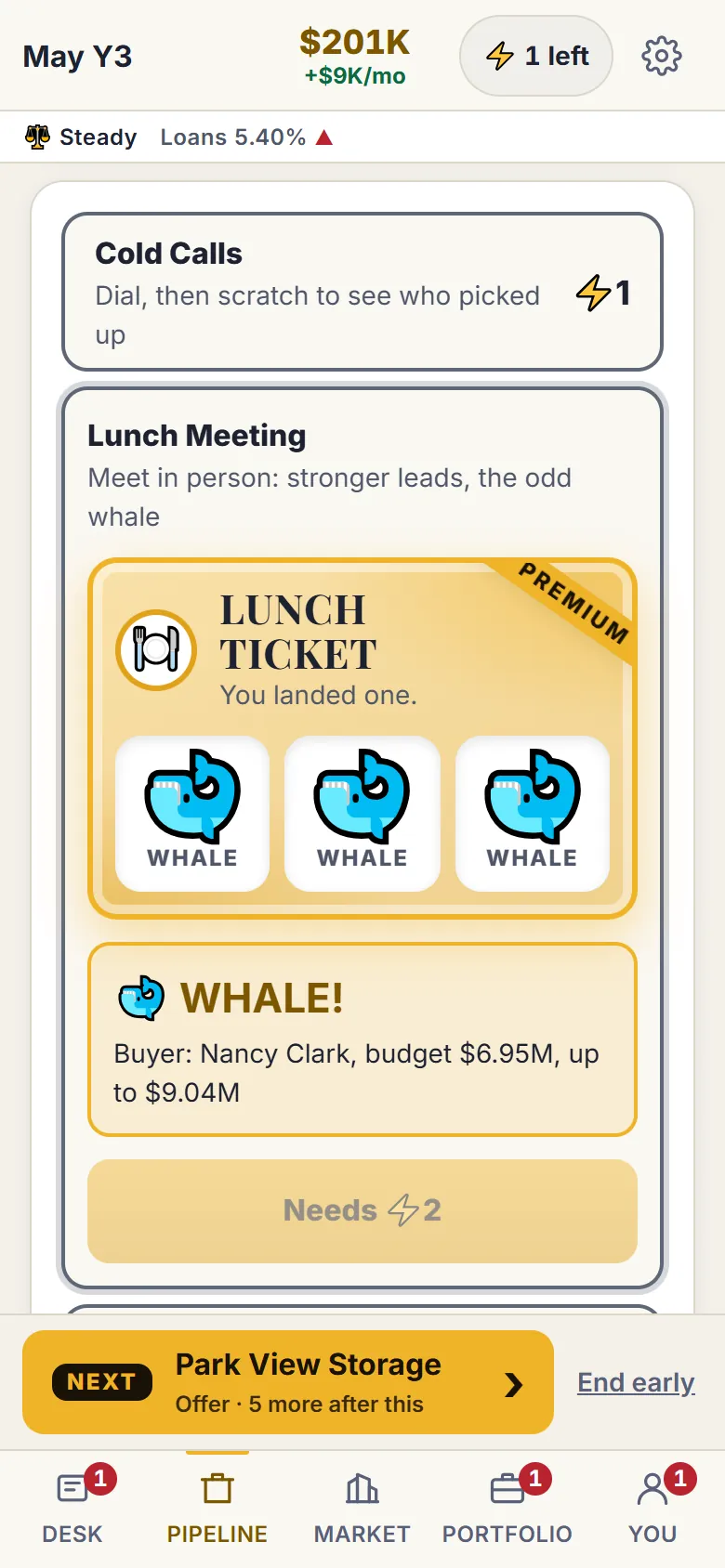
| Lunch Meeting | Three-window reveal · 2 actions | Meet in person: stronger leads, the odd whale | Close 3 deals |
| Networking Gala | Three-row reveal · 2 actions | Work the room: the keenest money in town | Own 2 buildings |
| The VIP Room | Three-window reveal · 3 actions | Private dinners with institutional money | Reach Mogul |
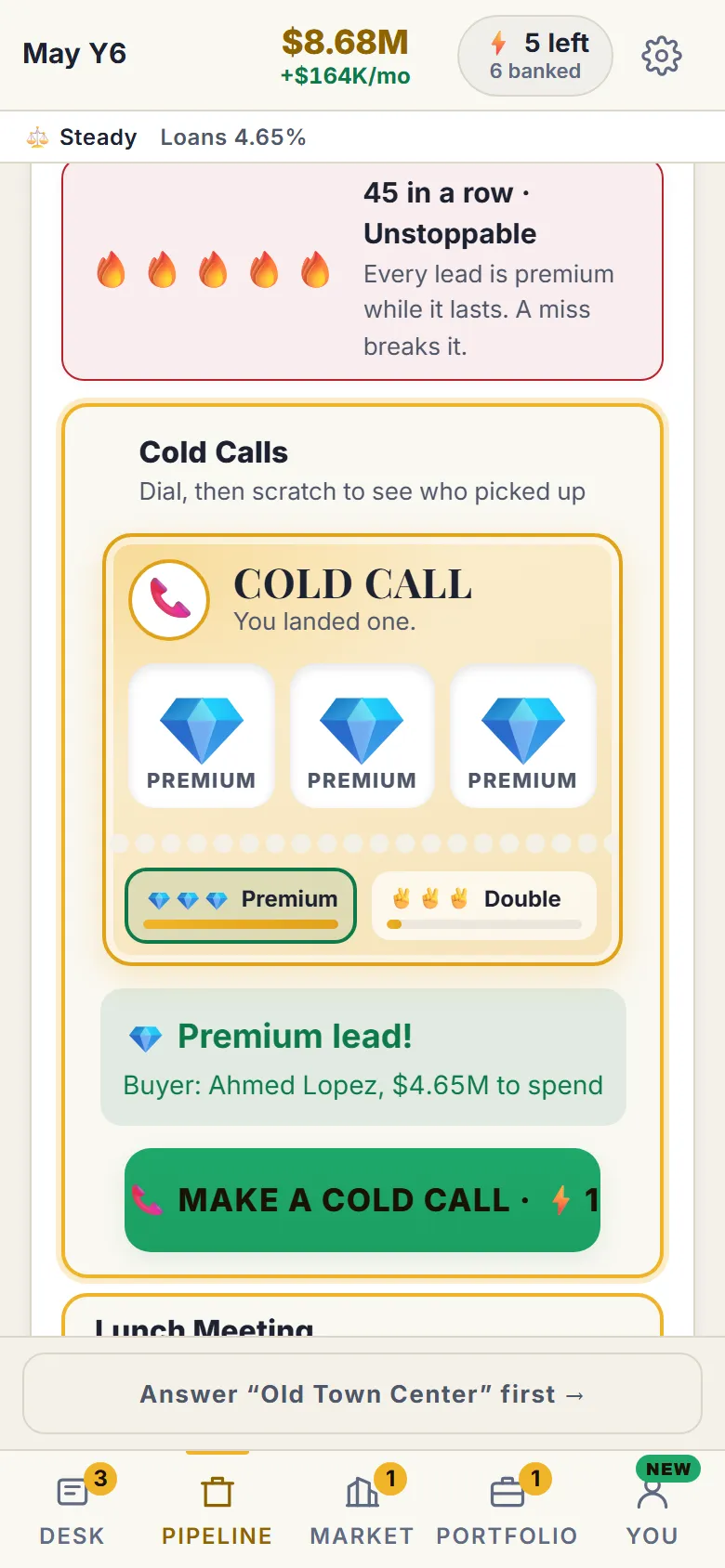
A cold call has three windows: open all three, and three matching is a lead. Most calls miss; a hit is a plain lead, a strong lead, or now and then a 💎 premium lead, a buyer with more money and more patience. The bigger tables can also turn up an off-market tip. The game decides the result first; the windows only show it. Your career's first 3 plays always land.
Whales
A 🐋 whale is the biggest client in town, a buyer for the top of what's open to you. Whales only come from the Lunch Meeting, Networking Gala and The VIP Room, never a cold call, and not before Broker rank, when Midtown opens. You can land one whale a year at most; in between, a whale roll is a premium lead.
Streaks and district stars
You prospect in one district at a time. Hits in a row build a streak there: Warming Up, then On Fire, Phone Blazing and finally Unstoppable, where every lead is premium. A miss breaks the streak.
Each district also has a reputation shown as up to five stars. Every call there builds it, and closing deals builds it faster. More stars mean fewer misses and better leads, and a little more chance of a whale. Your rank and your skills cut the misses too.
Buyer clients and the offer ladder
A buyer lead is someone with money to spend. Take the client, and their card shows the building that fits them best, with See all for the others they'll consider. An offer costs an action, and you pick the rung:
| Offer | Price | Seller says yes |
|---|---|---|
| Lowball | 85% of asking | About 30% to 50% |
| Fair | 95% of asking | About 55% to 75% |
| Full ask | The asking price | Always |
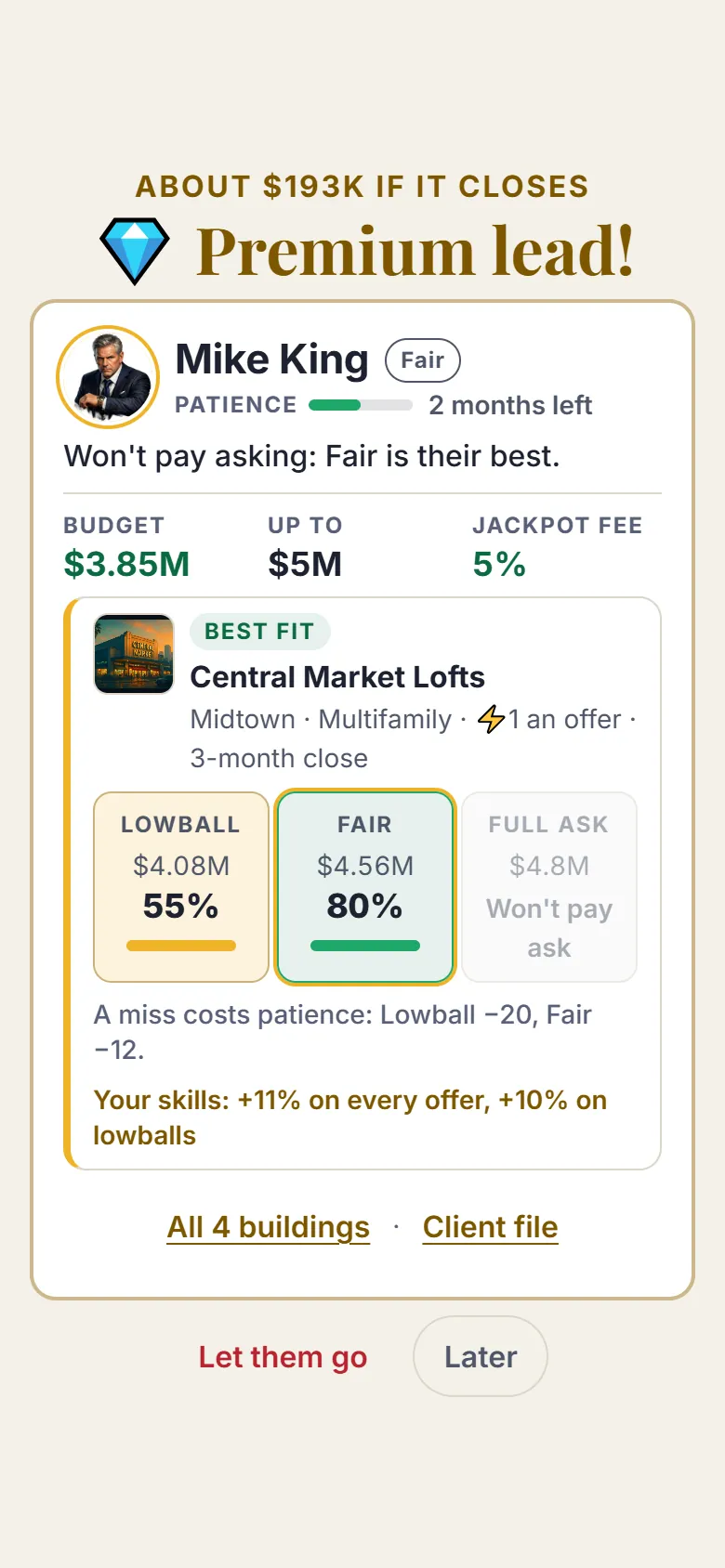
Each rung shows its odds and your commission. The seller's mood and how long the building has sat move the odds inside the band; a building that doesn't suit the client lowers them, and your offer skills raise them. A higher price pays a bigger commission, but costs the client a little patience, and a refused offer costs the action and some patience too. Your career's very first offer is a sure thing.
The client's stance caps how high they'll go. A keen client will pay asking; a firm one goes up to a fair offer; a lowballer writes lowballs, though you can talk them up to fair at a cost to their patience. If nothing fits, Search wider adds another district you've unlocked. Clients don't wait forever: each one shows how long until they sign with someone else. A buyer-side commission starts at 3% of the price.
Save a client money and they remember it. A purchase that closes at least 5% under asking makes a loyal client: about half the time, 3 to 8 months later, they come back for another building or send you a strong lead.
Listings
A listing pitch is a seller who wants a broker to sell their building. Pitch them and, if you win, the listing is yours. You start with a basic pitch at the standard 5% commission and a discount pitch at 3.5%. "Buy the Listing", which costs cash up front and lists the building higher, opens once you sign 4 listings. The Elite Pitch, at 6%, opens once you sell 3 listings of $2M or more.
A won listing asks for a marketing plan. Better plans draw more and stronger offers and cost money every month the building sits.
| Plan | A month | What it draws | Opens |
|---|---|---|---|
| Listing Service Only | Free | About one offer every 2–3 months, usually 85–92% of asking. | From the start |
| Standard Marketing | $3,000 | One or two offers a month, usually 90–97% of asking. | Sign 2 listings |
| Full Campaign | $6,000 | Two or three offers a month, some at or above asking. | Close a $5M deal |
| Institutional Launch | $12,000 | Several offers a month; bidding wars push past asking. | Close a $25M deal |
Offers then arrive on the Pipeline tab. For each one you can Accept, Counter at asking, or Pass. The card shows the odds the buyer takes your counter and what happens if they don't. A buyer you don't answer walks at the end of the month. Some sellers have a number of their own and may refuse an offer under it.
Standing Orders
At first every offer comes to you. Once you sell 3 listings, Standing Orders open: give each listing a standing answer and good offers are accepted for you at month end. Quick sale takes any offer at or above the seller's number; Hold for ask takes only offers at asking or more. You can still answer any offer yourself, and change the order on the listing.
Your seats, and your team
Working alone you can carry 2 listings and 2 buyer clients at once. When they're full, a new lead has to wait or go. From Associate, the first time that happens your team opens: hire a listing coordinator or a buyer's agent to carry more. See Your team.
Big deals pay a smaller share
Every commission, on a listing or for a buyer, pays its full rate on the first $2M of the price, 40% of the rate on the part from $2M to $10M, and 20% of it above that. A $10M sale on a 5% listing pays $260K; a $25M one pays $410K. Early deals are small and pay in full. Later on, the big money is in the buildings you own.
Escrow
An accepted offer goes into escrow (the period between a signed deal and the closing). Each deal gets a length when it opens: Quick closes at the end of the month you sign, Standard 1 month later, and Long 2 months later. The very biggest deals always take the long road. Your commission is paid when it closes, as a cheque you hold to deposit.
A Quick escrow closes clean; the longer ones can hit a problem, Long most often. A trouble card lands on the Desk with choices, odds and costs. The problems include:
- an inspection that finds something,
- an appraisal that comes in low,
- a title or tenant issue,
- a lender getting cold feet,
- a closing delay,
- a buyer trying to retrade, which means renegotiating the price after signing.
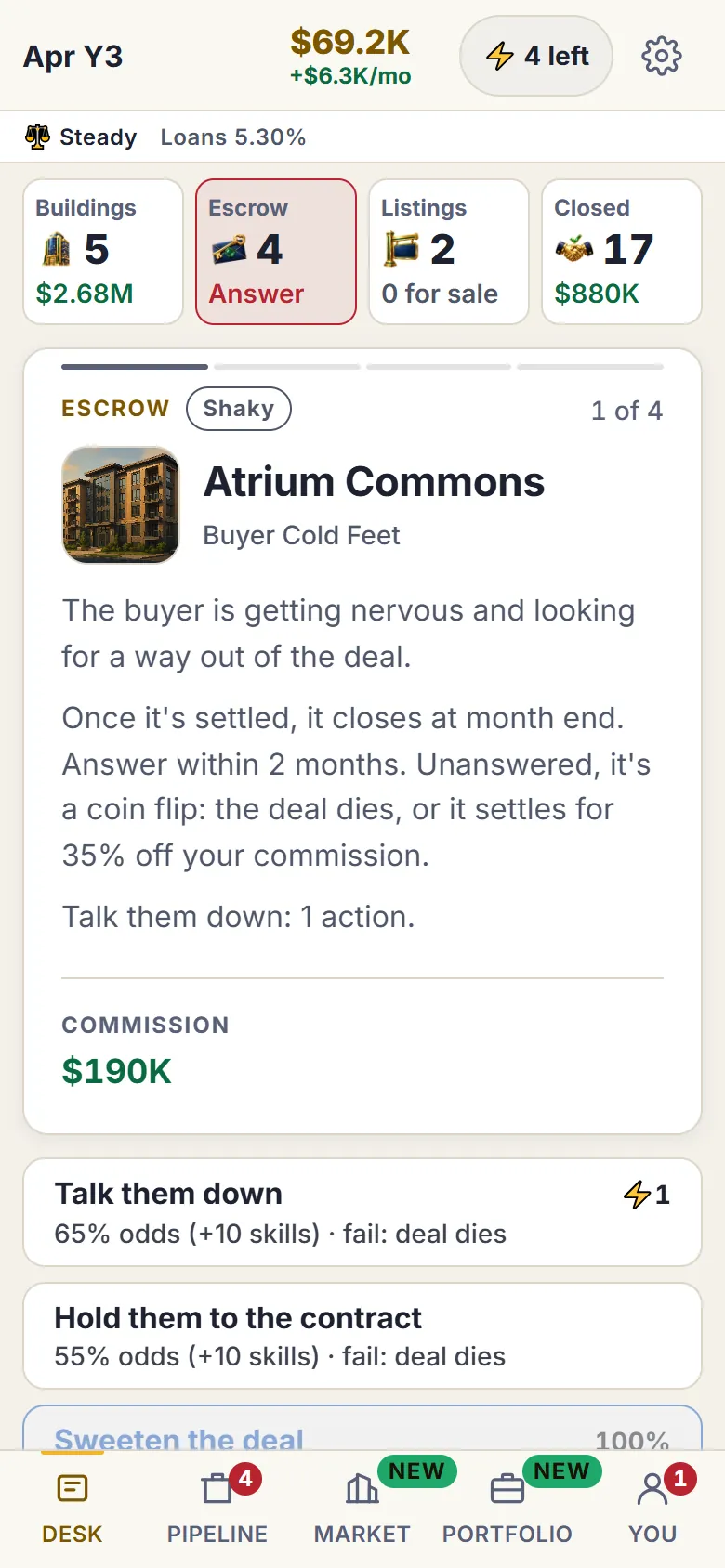
You have a limited time to answer. Leave it, and the problem gets settled without you, usually at the cost of part of your commission.
Marketing campaigns
Campaigns bring leads in every month without a call. They cost a setup fee plus a monthly spend, and their rows sit on the Pipeline under Prospect for leads, where you start and stop them. Each kind is earned by running the one before it:
- Direct Mailers. Targeted mailers to commercial property owners considering a sale. Opens: Make 20 calls.
- Digital Ads. Targeted online ads reaching active commercial real estate investors. Opens: Run mailers for 3 months.
- Billboard & Signage. High-visibility signage and billboards in a target submarket. Opens: Run digital ads for 3 months.
- Social Media Presence. LinkedIn thought leadership, market updates, and deal highlights. Opens: Run billboards for 3 months.
Try it on a real career
Free in your browser, on your phone or desktop. No download, no account.