
Learn
What is commercial real estate?
Property that exists to earn income: what it is, the four main types, who's involved, and the handful of numbers that run the business.
Updated October 6, 2026
Commercial real estate (CRE) is property owned to produce income from business use: office buildings, shops, warehouses and larger apartment buildings. The owner earns rent from tenants, and the building's value is judged mostly by how much income it reliably produces.
That last point is the big difference from buying a home. A house is priced by comparing it to similar houses nearby. A commercial building is priced mostly by its income.
Commercial versus residential
| Residential (homes, small rentals) | Commercial | |
|---|---|---|
| How value is set | Mostly comparable sales | Mostly income (NOI ÷ cap rate) |
| Typical lease | One year | Often three to ten years or more for business tenants |
| Who pays expenses | Usually the owner | Depends on the lease; tenants often share taxes and upkeep |
| Loans | Based on the borrower's income | Based largely on the building's income |
| Size of deals | Hundreds of thousands | Hundreds of thousands to hundreds of millions |
In the United States, lenders usually treat apartment buildings with five or more units as commercial property, even though people live in them. Smaller rentals are financed as residential.
The four main property types
Office
From suburban two-story buildings to downtown towers. Leases tend to be long, and landlords often pay for build-outs to win tenants. Demand follows white-collar employment, and since 2020 it has also followed how often people go into the office.
Retail
Neighborhood strips, shopping centers, single-tenant stores and restaurants. Location and traffic are everything. A grocery store "anchor" can keep a whole center busy; losing one can empty it.
Industrial
Warehouses, distribution centers and light manufacturing. Buildings are simple and relatively cheap to run, often on triple-net leases where the tenant pays most expenses. Growth in online shopping made logistics space one of the strongest sectors of the last decade.
Multifamily
Apartment buildings. Leases are short, so rents adjust to the market quickly, in both directions. Because people always need somewhere to live, investors tend to see it as one of the steadier property types.
Beyond these four are hotels, self-storage, medical offices, data centers, senior housing and land, each with its own quirks.
Building classes
Buildings are loosely graded Class A (newest, best located, highest rents), Class B (older but well kept) and Class C (older, needing work, lower rents). The grades are relative to the local market rather than a formal standard. A lot of investing is about moving a building up a class: buying a tired C, fixing it, and re-leasing it as a B.
Who does what
- Owners and investors buy buildings, from individuals with one strip center to pension funds and REITs with thousands.
- Brokers find buyers and sellers and negotiate the deal. They are usually paid a commission, a percentage of the sale price.
- Lenders (banks, life insurers, debt funds) make loans secured by the building.
- Property managers collect rent, handle repairs and keep tenants happy.
- Appraisers estimate value, usually for a lender.
- Tenants, whose rent pays for everything else.
How investing in it works
A typical deal has the same shape at any size:
- Find a building, often through a broker, and study its rent roll and expenses.
- Underwrite it: estimate its net operating income and what it's worth.
- Finance it: put down part of the price (often 25–35%) and borrow the rest against the building.
- Operate and improve it: fill vacancies, raise rents to market, control costs.
- Exit or recycle: sell, or refinance to pull cash out and buy the next one.
Owners make money three ways: cash flow from rent, the loan being paid down over time, and appreciation. The biggest gains usually come from raising a building's income, because value is a multiple of income.
The numbers that matter
- Net operating income (NOI): income collected minus operating costs, before the loan. Read more.
- Cap rate: NOI ÷ value. The market's price for a dollar of income. Read more.
- Loan-to-value (LTV): loan ÷ value. How much of the building the bank has financed.
- Debt service coverage ratio (DSCR): NOI ÷ annual loan payments. Lenders commonly want 1.20 or more.
- Cash-on-cash return: annual cash flow after loan payments ÷ the cash you invested.
Cycles and risk
Commercial property moves in long cycles. When the economy is strong and money is cheap, rents and prices rise and cap rates fall. When rates jump or a recession hits, vacancies rise, lenders tighten, and owners with too much debt can be forced to sell at the bottom. Leverage magnifies both directions. Most famous real estate fortunes, and most famous losses, came from how someone handled the turn of a cycle.
Seeing it in CRE Tycoon
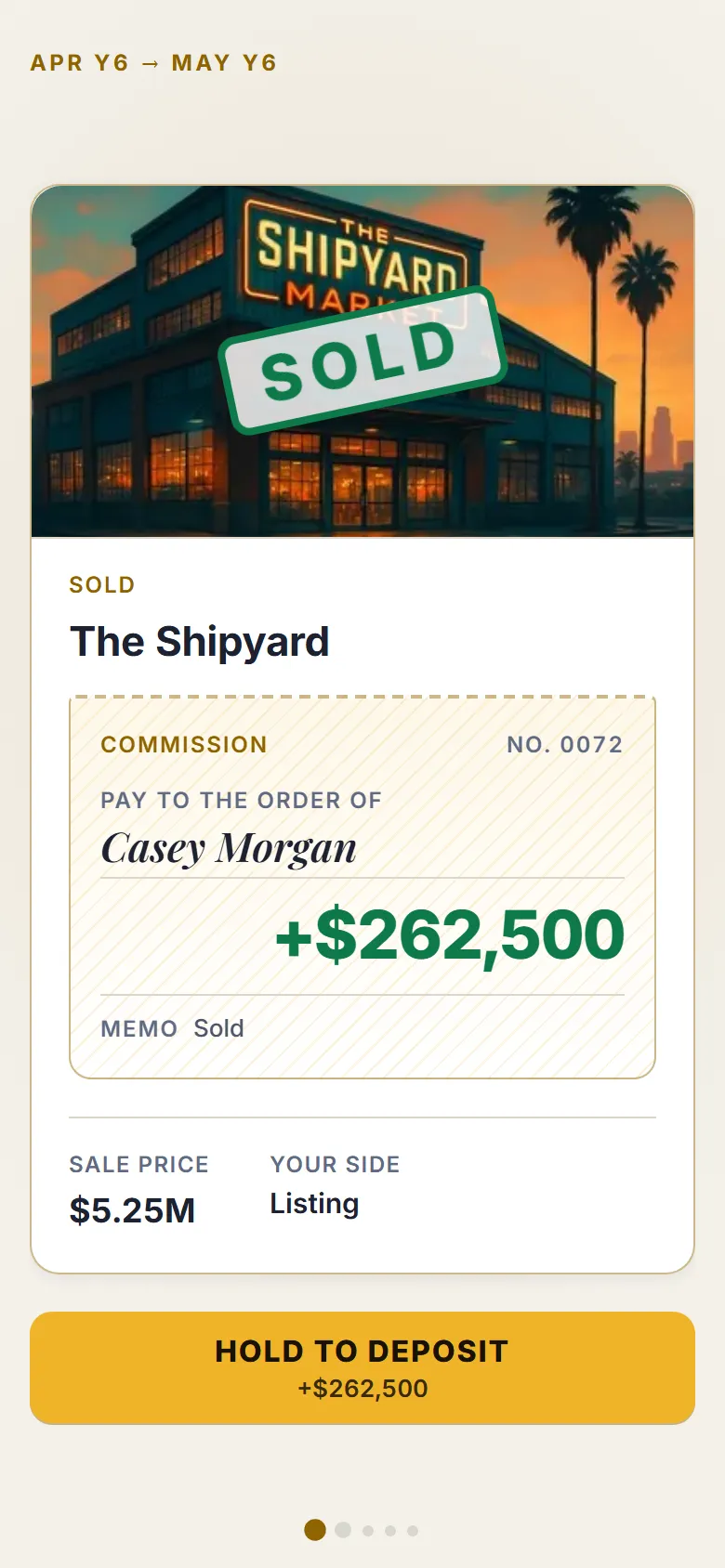
CRE Tycoon is a free browser game built on these ideas. You start as a broker with $100,000, earning commissions by listing buildings and finding buyers. With that cash you start buying: a down payment and a loan, then a business plan to lease the building up. All four property types appear across 4 districts, from small Class C walk-ups to trophy towers, and the market moves through cycles, with a benchmark loan rate that changes as you play.
It is a simplification. There are no lease negotiations clause by clause, and taxes are reduced to a few rules. But the core relationships are real: income sets value, debt magnifies results, and timing matters.
The short version
- Commercial real estate is income property: office, retail, industrial and larger apartment buildings.
- It is valued mostly on income, not on comparable sales.
- Brokers, lenders, managers and appraisers each play a part in every deal.
- Raise the income and you raise the value; use too much debt and a downturn can take it all away.
Try it on a real career
Free in your browser, on your phone or desktop. No download, no account.