
Player guide
Business plans
A building without a plan drifts. A plan is how you fill it, raise the rent and set up the big refinance, and the bigger the plan, the bigger the risk.
Updated October 20, 2026
A new building's first real decision is how you'll run it. Without a plan it never fills past 80% and its value slides. A plan lifts occupancy and income stage by stage, and when it's done the building is ready for the first windfall: a cash-out refinance. New to buying? Start with Buying and financing.
The ladder
There are 5 rungs. A Fix-Up is open from day one; the bigger plans are rank headlines, one promotion at a time.
| Plan | Rung | Opens at | Risk | Stages | For |
|---|---|---|---|---|---|
| Fix-Up | 1 | Rookie | Sure thing | 1 | Any building |
| Stabilize | 2 | Associate | Low | 2 | Any building |
| Value-Add | 3 | Senior Broker | Medium | 3 | Any building |
| Big Lease-Up | 4 | Managing Director | High | 3 | Office and retail and industrial |
| Reposition | 4 | Managing Director | High | 3 | Retail and office |
| Redevelop | 5 | Partner | Very high | 3 | Industrial and apartments |
- Fix-Up. Paint, repairs, a better rent. A small building, a quick job, no surprises. For buildings up to $1M, or any building until a bigger plan opens.
- Stabilize. Fix what is broken and fill the empty space. Steady, and hard to get wrong.
- Value-Add. Make the building better than it was: better space, better tenants, higher rents.
- Big Lease-Up. Fill a mostly empty building, tenant by tenant. One big tenant can make it or break it.
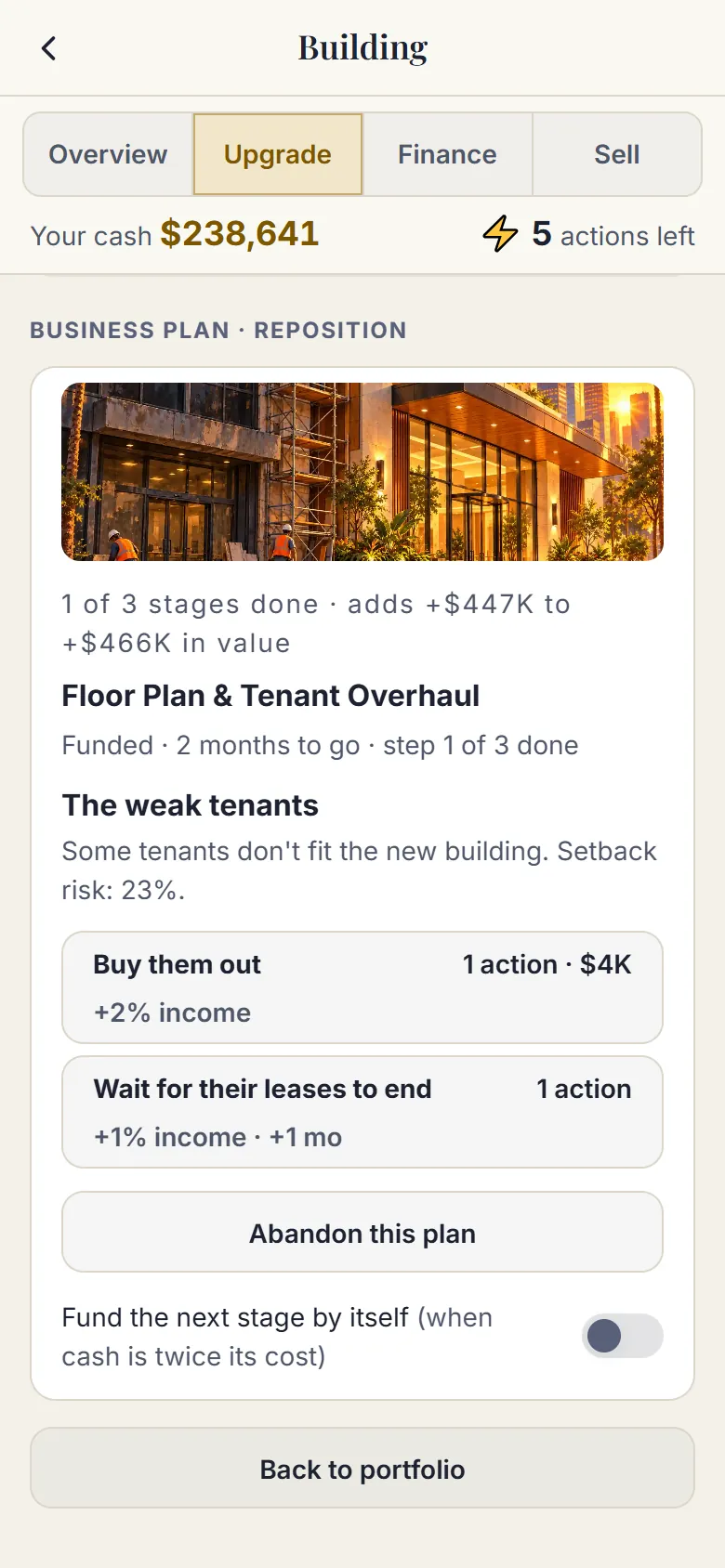
- Reposition. Give the building a new identity: new tenants, a new look, a new class.
- Redevelop. Empty it and rebuild it. The biggest cost, the longest wait, the biggest payoff.
The plan card shows how well each plan suits the building. A good fit lifts more; the wrong tool lifts less. A Big Lease-Up suits a mostly empty building; a Value-Add suits a tired one; on a full, leased building the heavy plans are the wrong tool.
Stages and steps
A plan is one to three stages. Each stage is funded with cash, then runs for a few months. While it runs, it asks for 3 steps: cards with two choices each, like a basic or a premium facade, doing the leasing yourself or hiring it out. A choice costs cash, actions, or both, by who does the work. It may also take a month off the stage or add one, and nudge the building's occupancy and income. Neither choice is simply better: each wins on something.
When a stage's months run out and its steps are done, it completes and lifts the building's occupancy and income. Then the next stage is yours to fund.
Fast-track
In a hurry? Fund a stage on the fast track: it costs 25% more and takes half the months.
Setbacks
Every step taken on a plan above Fix-Up can hit a setback: the contractor walks off, the work runs over budget, the city holds the permit, tenants complain about the noise, the materials are late, or the work fails inspection. A setback is a card with two answers, and the stage waits for it. A Fix-Up never has one; the odds rise with each rung, up to Redevelop. A plan that suits the building has fewer, and some step choices (a proven crew) lower them.
Stalls
If a stage's months run out with steps still untaken, it stalls until you take them. On Value-Add, Big Lease-Up, Reposition and Redevelop, a stalled stage also costs 1% of its price every month it sits.
The market matters
A hot market makes the work dearer but brings fewer setbacks and faster leasing. A cooling or falling market makes it cheaper, with more setbacks and slower leasing. The plan card says which you're in.
Giving up
Value-Add, Big Lease-Up, Reposition and Redevelop can be abandoned partway if it goes badly. What you've spent is gone, and that plan won't be offered on that building again. A Fix-Up and a Stabilize are steady jobs that always finish, so they can't be abandoned.
A second plan
A building gets 2 plans at most. After the first is done, the only plan that can follow is a Reposition or Redevelop, on the building types it's open to, once you reach its rank. A Reposition and a Redevelop empty part of the building as they start, so its income dips before it climbs.
When it's done
A finished plan pays a small completion bonus, earns XP and path XP, and leaves a fuller building with higher income. That's the moment to look at its Cash out? card: see Refinance and sell. Then Upgrades push a full building's value further.
Try it on a real career
Free in your browser, on your phone or desktop. No download, no account.